Chemical Warfare Under the Hood: Why the Wrong Coolant Formula is a Summer Dealbreaker
It’s over 100 degrees out in Phoenix, you dropped your coffee in the driveway, and you’re running late to work. Just when you thought things could not be going more wrong, that pesky “low coolant” light pops on the dashboard as soon as you start your vehicle to head out. Since there’s no time to stop by your local auto repair shop, you head to the nearest auto parts store and stare at a wall of mysterious neon-colored fluids. Without thinking too much, you take a gamble, grab a gallon, and hope for the best – it’s all just coolant, right?
Wrong. Using the incorrect coolant can cost your engine, which is easily a $5,000+ replacement. Coolant isn’t just a one-size-fits-all, it’s chemically engineered to fit your vehicle. Using the incorrect chemical compound can cause severe engine damage, corrosion, water pump failure, and overheating, leaving you stranded in the Phoenix heat.
Why Coolant Colors Matter
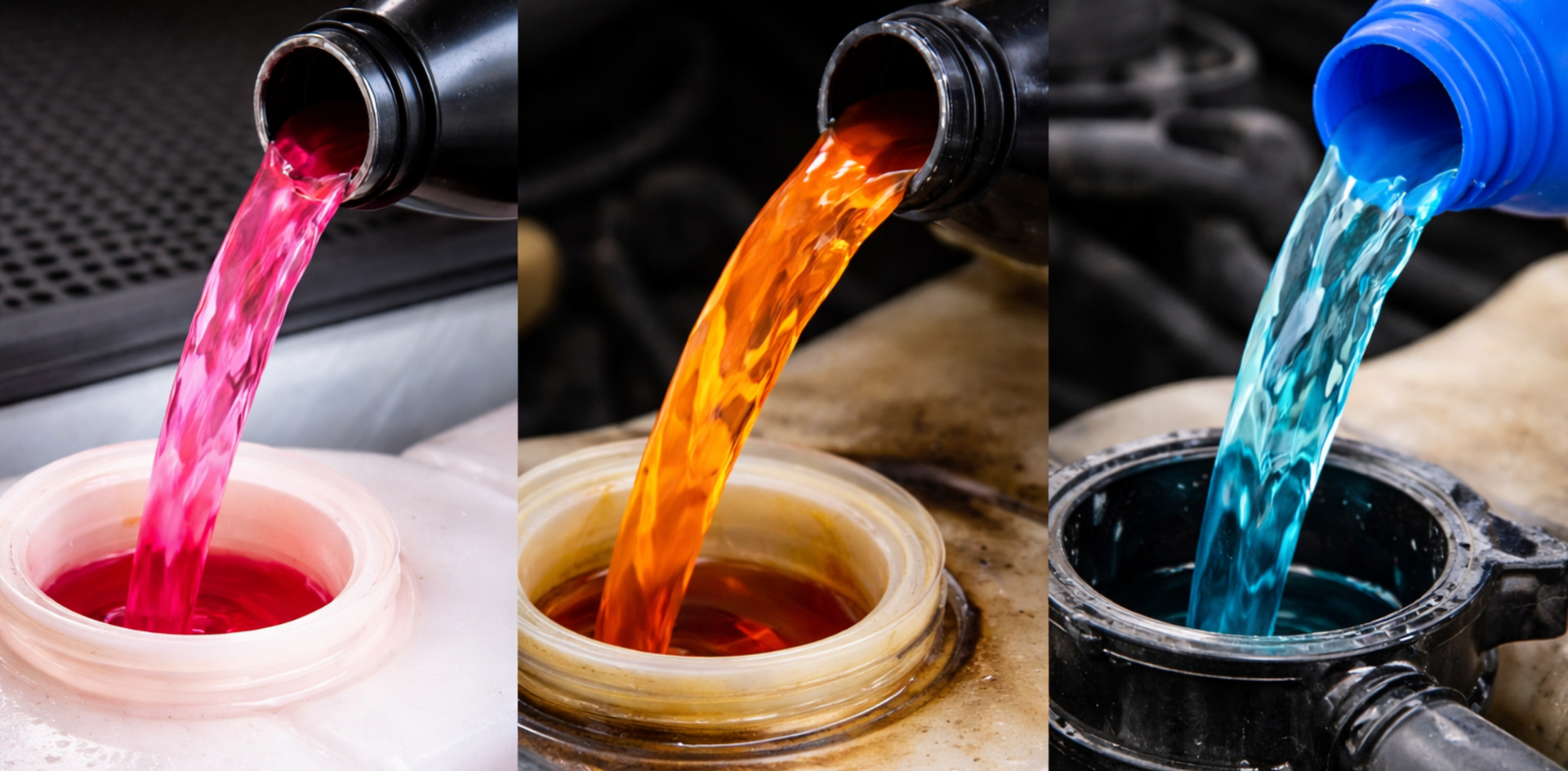
Coolant comes in a variety of different colors: neon green, orange, red, pink, blue, yellow, and purple. This isn’t just for cosmetic reasons, but rather to distinguish between different chemical formulas. Each gallon color is created with a different additive package which helps to protect your engine from corrosion, rust, and mineral buildup.
Modern vehicles typically use one of three main formulas:
- IAT (Inorganic Additive Technology) – Classic neon green color, typically used in order cars.
- OAT (Organic Acid Technology) – Ranges from shades of orange to red, and popular among GM (General Motors) and other modern vehicles.
- HOAT (Hybrid OAT) – A hybrid formula often blue, yellow, or pink, commonly used by European and Asian vehicle manufacturers
While color is a great base guide for finding which coolant your vehicle needs, it isn’t always a 100% guarantee. If you find yourself unsure of which bottle matches your car’s specific needs, it’s best to look at your vehicle’s manual for clarification or connect with a professional at your local auto repair shop.
The Chemistry of the "Jell-O" Effect
So, you’ve accidentally mixed two different coolant formulas, now what? Pouring the wrong coolant into your system causes the additives to clash. Instead of protecting your engine, the chemicals can react with each other and turn into a thick, brown gel or sludge. In the auto repair industry, this gelatinous substance is often referred to as the “Jell-O Effect.”
This gel can be particularly destructive to your vehicle. It can create severe internal clogs in the radiator, heater core, and engine passageways, restricting coolant flow throughout the system. When coolant can’t circulate properly, your engine loses its ability to regulate temperature effectively, which can lead to:
- Engine Overheating
- Radiator and Heater Core Blockages
- Corrosion and Internal Engine Damage
- Premature Water Pump Failure
- Costly Repairs or Even Engine Replacement
Coolant Fluid Exchange in Phoenix
If you recently topped off your coolant with the incorrect formula, the best solution is a professional coolant fluid exchange to properly correct the issue. At Precision Tire and Auto Center, our experienced ASE-certified technicians use specialized equipment to remove the contaminated coolant from your vehicle and replace it with the manufacturer-recommended formula.
A complete cooling system flush helps remove corrosion, rust, and deposits caused by the “Jell-O Effect,” restoring proper coolant flow throughout the engine. In doing so, we can help “reset” your cooling system and precent further damage.
If you’re ready to schedule your appointment, give us a call today at 623-582-4545 or book online today!