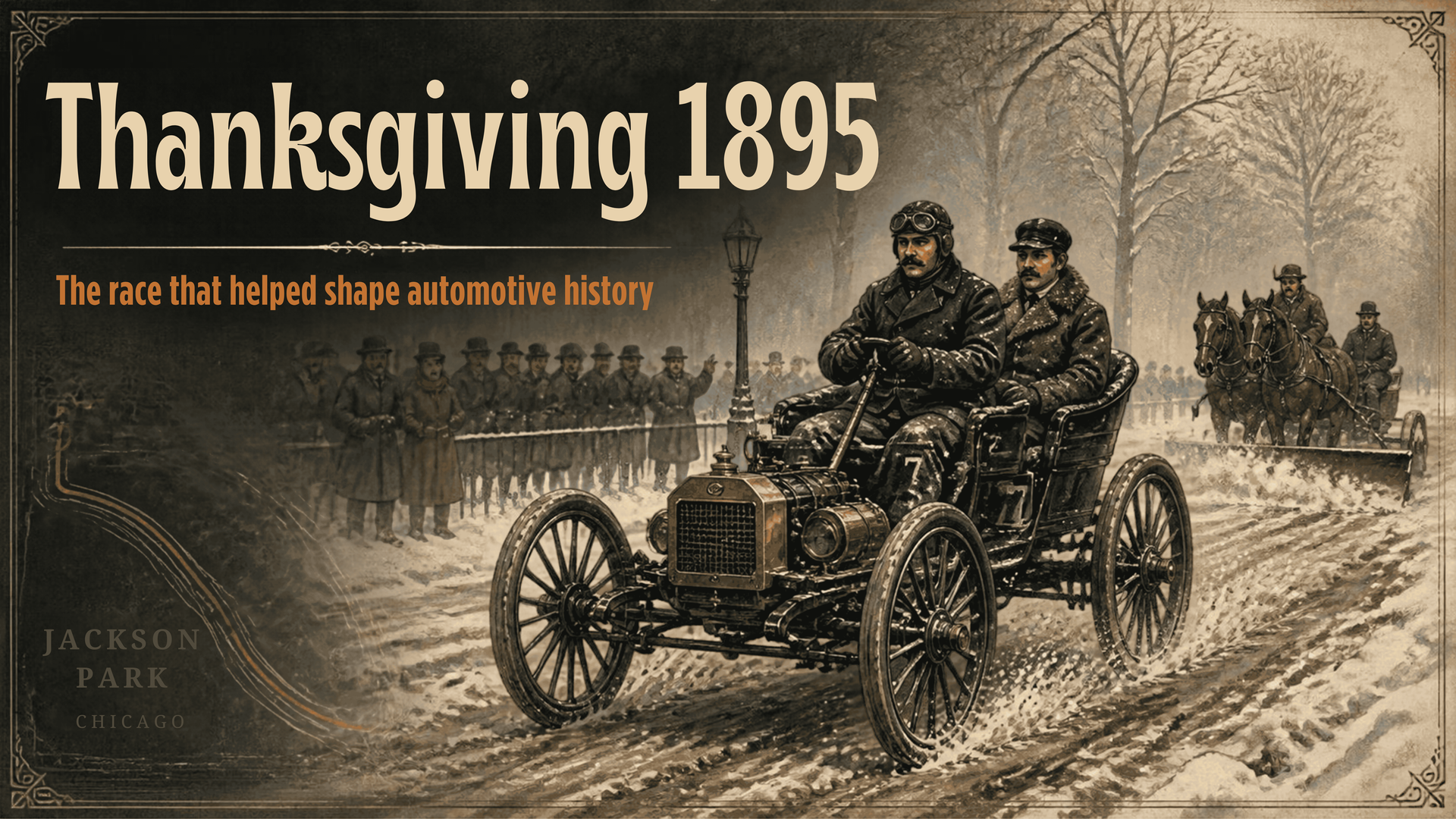
Forget the dinner table, we're taking Thanksgiving back to the streets.
Thanksgiving is a time for family, food, and football, but it’s also a day that helped shape automotive history.
Flash back to November 28, 1895. While families across the country were celebrating Thanksgiving, automobiles were making history. Six early automobiles lined up in Jackson Park in Chicago for a race that would put these strange new “horseless carriages” to the test.
The Invention That Replaced the Horses
Before cars, horses and horse-drawn carriages dominated the roads. Inventions like the automobile were still experimental at the time and looked a lot different than the vehicles we drive today.
As automobiles started gaining momentum, they were often called “horseless carriages” – an invention that had the potential to change the way people traveled.
To put these new automobiles to the test, the Chicago Times-Herald newspaper organized a competition to see which one could travel the farthest and fastest. The goal was simple: put these strange new machines to the test and see if they could actually prove themselves as a practical way to get from one place to another.
Competitors would travel from Chicago to Evanston and back, covering roughly 54 miles. And while 54 miles may not seem like much of a challenge today, in 1895, it was a pretty big deal. This race was about more than speed—it was a chance to show that these strange new machines could actually handle the roads and make it from point A to point B.
Snow, Slush, and Six Vehicles
Chicago weather can be unpredictable, which is why, after several postponements, race day landed on Thanksgiving. And the ironic part? Portions of the route were covered in snow and slush, so a horse-drawn snowplow was used to clear parts of the course before the race even started.
The harsh conditions took quite a toll on some of the racing automobiles, causing mechanical failures and other issues that forced several competitors out of the race. In the end, only two of the six vehicles were able to complete the entire course.
Out of the two vehicles, J. Frank Duryea crossed the finish line first in a vehicle built by the Duryea brothers. While he was victorious, the win didn’t come without its struggles. The vehicle experienced mechanical trouble during the race that required repairs, but after more than 10 hours of perseverance, it finally made it across the finish line with a whopping average speed of 7.3 miles per hour.
From Horseless Carriages to Holiday Traffic
While it took over 10 hours to travel 54 miles, this was more than just your average automobile race. This was a chance to show the public what this strange new invention could do and open up a world of possibilities. The Duryea vehicle showed that American-built automobiles could successfully complete a challenging long-distance race, giving the developing American auto industry some much-needed attention.
And on that Thanksgiving Day, these early automobiles gave people a glimpse of what the future of transportation could look like. More than 130 years later, automobiles have come a very long way.
So, this Thanksgiving, while you're enjoying the turkey, football, family, and maybe a little post-dinner traffic, remember that Thanksgiving has a pretty interesting place in automotive history.
And thankfully, your drive to dinner probably won't take 10 hours.
Happy Thanksgiving from all of us at Precision Tire and Auto Center – AZ!